Project: Solar-Powered Chemical Injection Skid System
Project Overview
Client Name: Solar Injection Australia
Location: Saudi Arabia
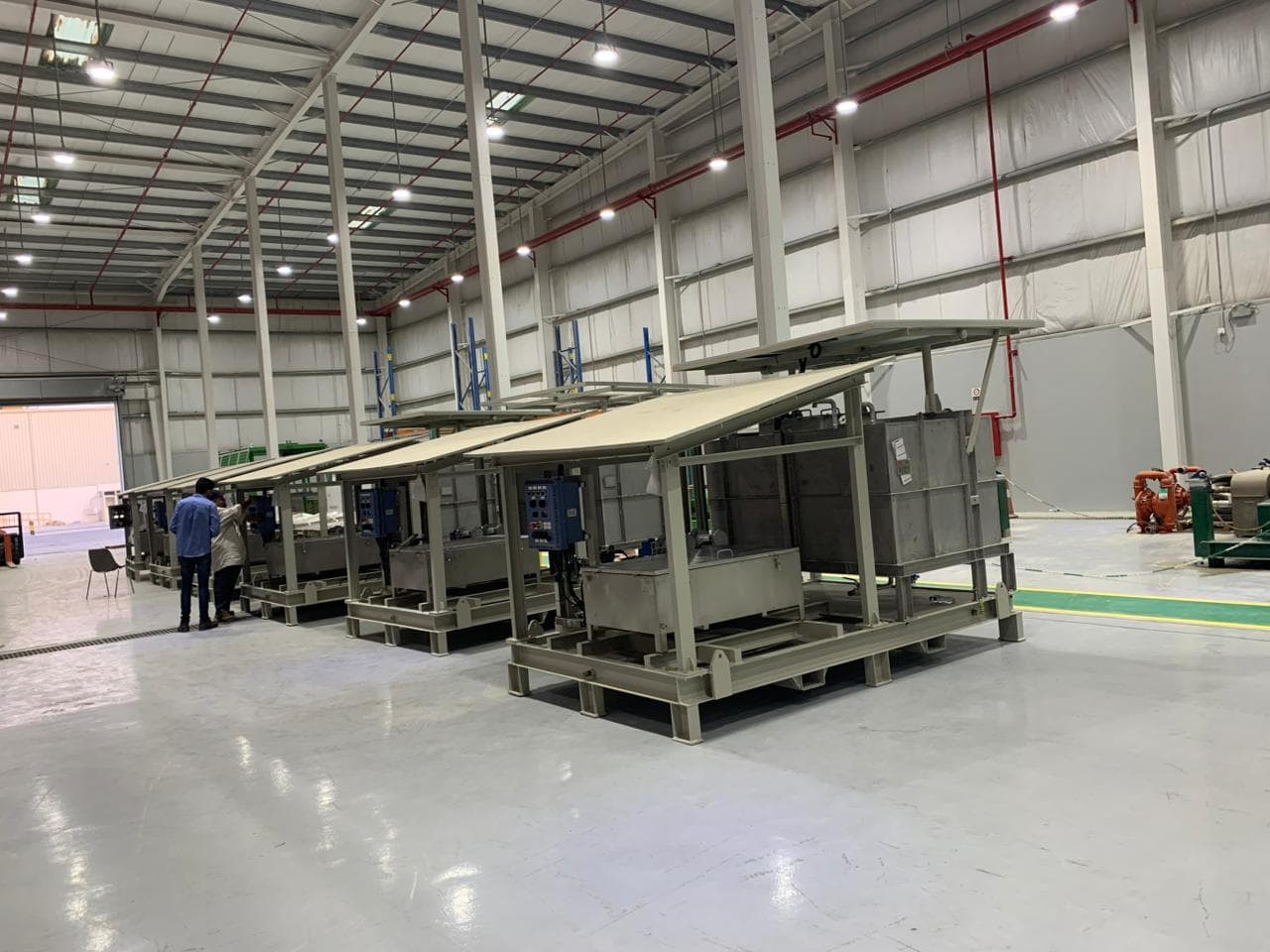
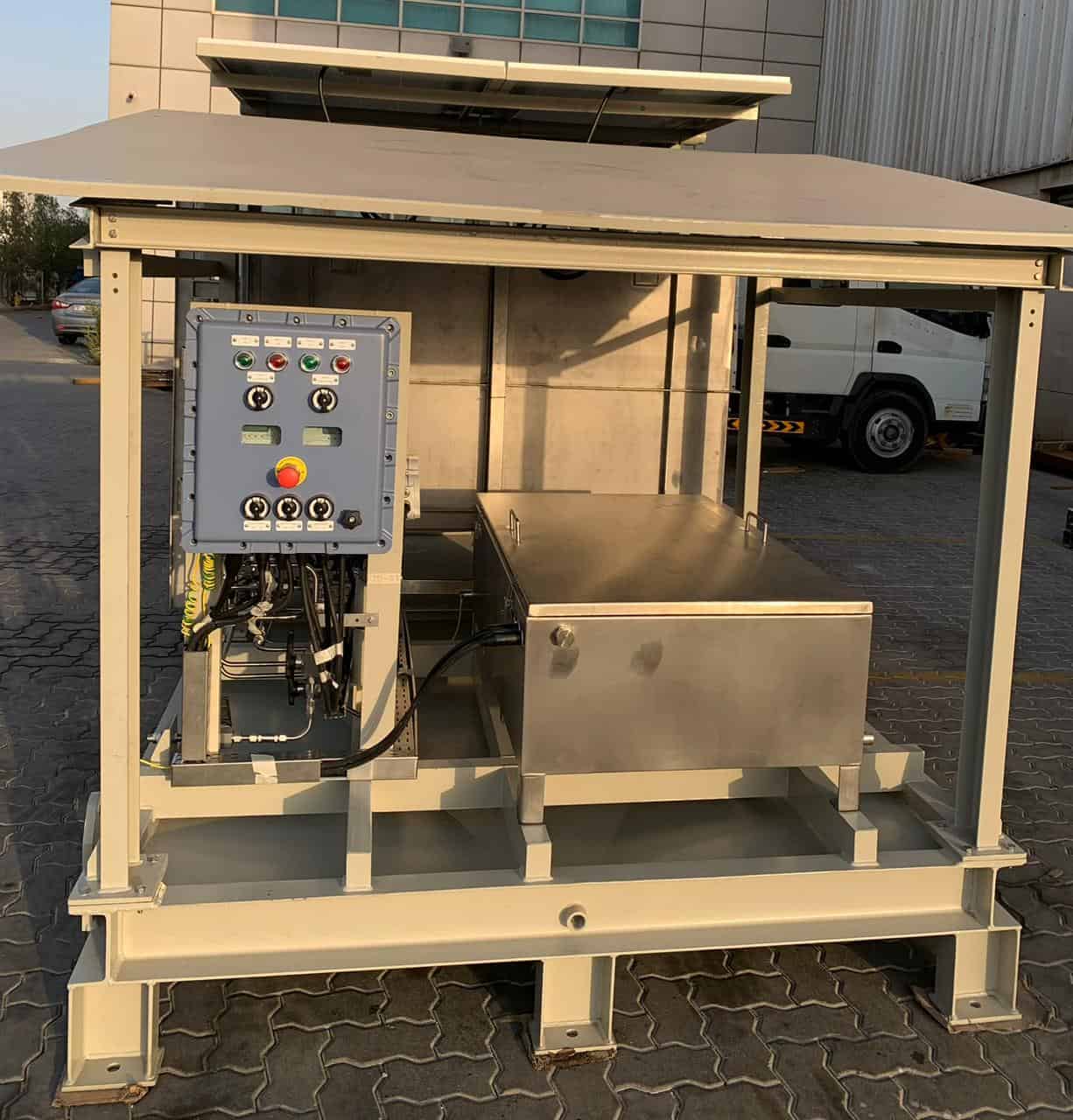
DS Energy UK Ltd, working alongside principal contractor Solar Injection Australia, designed, supplied, installed, and commissioned a fleet of 16 stand-alone solar power systems for Zamil Offshore in Saudi Arabia. Each unit powers a Chemical Injection Skid operating continuously within a Zone 2 hazardous area — dosing corrosion inhibitors, scale inhibitors, and process chemicals into live production pipelines with no connection to any mains infrastructure.
The systems were built around a 24 VDC architecture using Ameresco 395 W solar panels and Morningstar Genstar ProStar 30A charge controllers, with ATEX/IECEx-certified battery banks in two capacities — 4.5 Ah (5 units) and 6.1 Ah (11 units) — selected to match individual site load profiles. Remote monitoring is provided across all units via Doovit RTUs with 4G connectivity, giving operations staff real-time visibility of every system from a single location.
Full ATEX and IECEx compliance was achieved across every component — panels, batteries, charge controllers, enclosures, wiring, and junction boxes — with a complete hazardous area documentation package delivered on handover.
Chemical injection is not optional in oil and gas production — it is one of the more unglamorous but genuinely critical aspects of keeping pipelines healthy. Without continuous dosing of corrosion inhibitors and scale preventers, internal pipeline degradation accelerates quickly, flow assurance suffers, and maintenance costs climb. The skids themselves are relatively simple; the challenge is keeping them powered and monitored reliably in locations that have no grid, no onsite staff, and temperatures that will test most standard electrical equipment.
Zamil Offshore operates across multiple remote production sites on the Arabian Gulf where conventional power infrastructure is either absent or impractical to install. The original brief called for a proven, certifiable solar solution that could be replicated across 16 locations without significant site-by-site engineering work. Solar Injection Australia, as principal contractor, brought DS Energy UK Ltd in to handle the solar power system design, supply, and commissioning — a scope that turned out to be more technically involved than a standard solar install, given the Zone 2 classification and the heat
Challenge:
Several constraints shaped the design from the start:
- Zone 2 certification across all components. The entire power system — not just an enclosure or two — had to be ATEX/IECEx-certified for Zone 2 operation. That ruled out any off-the-shelf commercial solar equipment and required sourcing panels, batteries, charge controllers, RTUs, enclosures, glands, and conduit that all carried the right certifications and could be shown to be compatible.
- Arabian Gulf ambient conditions. Sustained high temperatures and intense solar irradiance create a difficult environment for batteries in particular. Thermal stress accelerates degradation, and overcharge in high-heat conditions can be destructive. The charge controller configuration had to account for this directly.
- Two different battery capacities across 16 units. The 5 units on 4.5 Ah and 11 units on 6.1 Ah reflected different skid load profiles at different sites. Both variants had to be fully certified and documented, which doubled some of the compliance work.
- Unmanned, remote sites. There is no practical option to send someone out every time an alarm trips. Real-time remote monitoring was a hard requirement — not a nice-to-have — and the communications solution had to work reliably in remote Gulf locations where cellular signal is variable.
- Sixteen units needed to be delivered, installed, and commissioned on a consistent timeline. The design had to be repeatable without every site requiring bespoke engineering decisions.
Solution:
Solar Array and Power Source
The primary generation source is an array of Ameresco 395 W monocrystalline solar panels — one of the few panel types available with the ATEX/IECEx certifications required for Zone 2 installation. Panel configuration was sized to meet the daily load of each skid variant and maintain adequate battery charge under the conservative irradiance assumptions used for Arabian Gulf conditions, including dust accumulation losses and high-temperature power derating.
Battery Banks
Energy storage is provided by deep-cycle battery banks in two sizes: 4.5 Ah for the lighter-load sites and 6.1 Ah where the skid draw was higher. Both configurations are housed in explosion-proof enclosures rated II 2G Ex e IIB T5 Gb, certified under IECEx (INE 10.0015X) and ATEX (INERIS 00ATEX0021X). The enclosure ratings were chosen to match the site temperature classifications and the IIB gas group relevant to the chemicals being dosed.
Autonomy at each site was calculated on worst-case consumption figures to ensure the batteries could sustain operation through low-irradiance periods without reaching damaging depth-of-discharge levels.
Charge Controller
The Morningstar ProStar 30A, rated IECEx Ex ec ic IIC T5 Gc, handles all charge regulation. It was programmed with site-specific parameters: charge and discharge voltage thresholds, temperature-compensated charging curves, depth-of-discharge limits, equalization cycles, and automatic load disconnect. Temperature compensation is not optional in this environment — without it, the controller would continue pushing current into batteries that are already hot, shortening their life considerably. The controller’s configurable load disconnect also protects against over-discharge during extended periods of poor irradiance.
Remote Monitoring
A Doovit RTU with a 4G antenna is installed at each site, housed in a Zone 2 certified enclosure. It feeds real-time battery voltage, state of charge, and fault alarms back to operations staff regardless of where they are. For 16 unmanned sites spread across remote oilfield locations, this is a practical necessity — it allows the team to detect a degrading battery or a charging fault before it becomes a production issue, without having to drive out to check.
Hazardous Area Architecture
All internal power and control components sit within Ex db IIB+H2 T6 GB rated explosion-proof enclosures. Every external connection point — cable entries, conduit runs, junction boxes — was installed to IEC 60079 Zone 2 requirements, with certified Ex glands throughout. Nothing non-certified was permitted within the Zone 2 boundary. The solar array itself sits outside the classified zone where practicable, with certified wiring and protection devices at the zone boundary.
System Architecture
Each of the 16 units comprises:
- Solar PV Array — Ameresco 395 W ATEX/IECEx-certified monocrystalline panels; array sized per site load profile.
- Battery Bank — Deep-cycle cells in Ex e IIB T5 Gb certified enclosures; 4.5 Ah (5 units) or 6.1 Ah (11 units) depending on site load.
- Charge Controller — Morningstar ProStar 30A, 24 VDC, IECEx certified; programmable multi-stage regulation with temperature compensation and load disconnect.
- Main Enclosure — Ex db IIB+H2 T6 GB explosion-proof enclosure housing all internal electrical and control components.
- Doovit RTU — Zone 2 certified remote terminal unit with 4G antenna; real-time monitoring of battery status, voltage, and fault conditions.
- Wiring and Glands — All cabling, conduit, and junction boxes installed to IEC 60079 Zone 2 requirements with certified Ex glands throughout.
Project Execution
DS Energy UK Ltd held design, supply, installation, and commissioning responsibility across all 16 units.
- The design phase produced certified equipment schedules, single-line diagrams, battery autonomy calculations, charge controller configuration sheets, and a Hazardous Area Design Dossier. Two skid variants — 4.5 Ah and 6.1 Ah — were fully documented separately to support independent ATEX/IECEx compliance packages for each configuration.
- Equipment was sourced with full certification traceability. ATEX and IECEx certificates, Ex markings, and temperature class compliance were verified at point of order and confirmed on receipt. No equipment entered site without a complete certification file.
- Units were assembled in a controlled workshop environment. Enclosure builds, wiring, gland installations, and controller programming were completed and verified before dispatch.
- Factory Acceptance Testing. Each unit was tested under load prior to shipment, confirming charge controller operation, battery protection thresholds, RTU connectivity, and alarm outputs against the design specification.
- Installation and Commissioning. On-site installation covered panel mounting, cabling, Zone 2 boundary checks, and final commissioning of all 16 units. Charge controller parameters were confirmed under actual load conditions, and RTU data feeds were validated through to the remote monitoring platform.
- Documentation and Handover. The full delivery package included ATEX certificates, IECEx certificates, approved drawings, RAMS, P&IDs, charge controller configuration records, and Operation and Maintenance Manuals — one complete dossier per unit.
Features:
Technical Highlights
Full Zone 2 Component Certification
What makes this project unusual is the scope of the certification requirement. It is relatively straightforward to put standard solar equipment inside a certified enclosure. It is considerably harder to certify the solar panels themselves, the batteries, the charge controller, and every connection point throughout the system. Every component in these 16 units carries the relevant ATEX or IECEx mark — there are no concessions or workarounds in the design.
Temperature-Compensated Charge Management
The Arabian Gulf is a difficult environment for batteries. Ambient temperatures regularly exceed 45°C, and the cells inside an enclosure in direct sun can run hotter still. The Morningstar ProStar was configured with temperature compensation curves, adjusted discharge limits, and equalization cycles tuned for these conditions. Getting this right matters — a misconfigured charge controller in high heat will destroy a battery bank in a fraction of its expected service life.
Two-Variant Fleet Design
Running a 16-unit fleet with two different battery capacities and matching the documentation, certification, and commissioning records for each variant required careful configuration management. Both variants share the same core architecture and equipment list, which kept the logistics straightforward, but the distinct compliance packages for each ensure that site-level maintenance teams and inspectors have an accurate record of what is installed where.
Remote Monitoring Across All 16 Sites
The Doovit 4G RTU gives the operations team a real picture of what is happening at every site without needing to visit. State of charge trends, voltage readings, and fault alarms are available in real time. In practice this means a degrading battery gets flagged before it trips the skid, and a charging fault gets picked up before the reserves run down — which is exactly how you want unmanned remote infrastructure to be managed.
Results and Benefits
| ✔ 16 solar power systems delivered, installed, and commissioned on schedule |
| ✔ Full ATEX and IECEx Zone 2 compliance across all components on all units |
| ✔ Zero mains infrastructure dependency — fully autonomous off-grid operation |
| ✔ Real-time 4G remote monitoring across all 16 sites via Doovit RTU |
| ✔ Temperature-compensated charge management protecting battery life in Arabian Gulf conditions |
| ✔ Two certified battery variants (4.5 Ah and 6.1 Ah) matched to individual site load profiles |
| ✔ Complete compliance documentation package delivered per unit on handover |
| ✔ Repeatable, scalable design — additional units deployable without new engineering |
Removing diesel generation from these sites eliminates ongoing fuel logistics, reduces maintenance call-outs, and cuts emissions. Given that the skids are largely unattended and the sites are remote, the value of a system that runs without intervention — and tells you when something is about to go wrong before it does — is substantial. The design is proven and replicable; any future expansion of Zamil’s chemical injection programme can use the same architecture without starting the engineering process again.
Key Project Data
| Parameter | Details |
| End User | Zamil Offshore |
| Principal Contractor | Solar Injection Australia |
| Solar Integrator | DS Energy UK Ltd |
| Location | Saudi Arabia |
| Application | Solar-Powered Chemical Injection Skid (Zone 2) |
| System Voltage | 24 VDC |
| Solar Modules | Ameresco 395 W (ATEX/IECEx certified, Class I Div 2) |
| Charge Controller | Morningstar ProStar 30A — IECEx Ex ec ic IIC T5 Gc |
| Battery Bank — Variant A | 4.5 Ah deep-cycle | Ex e IIB T5 Gb | 5 units |
| Battery Bank — Variant B | 6.1 Ah deep-cycle | Ex e IIB T5 Gb | 11 units |
| Total Units Delivered | 16 (5 × 4.5 Ah + 11 × 6.1 Ah) |
| Main Enclosure Rating | Ex db IIB+H2 T6 GB |
| Battery Enclosure Cert. | IECEx INE 10.0015X | ATEX INERIS 00ATEX0021X |
| Remote Monitoring | Doovit RTU with 4G antenna (Zone 2 certified enclosure) |
| Hazardous Area Standard | ATEX Directive 2014/34/EU | IEC 60079 Series (IECEx) |
| Zone Classification | Zone 2 — Gas Group IIB, Temperature Class T5/T6 |
| Installation Standard | IEC 60079 Zone 2 throughout |
| Charge Management Features | Temp-compensated charging | DoD limits | Equalisation | Load disconnect |
| Documentation Delivered | Hazardous Area Design Dossier, ATEX/IECEx certs, RAMS, P&ID, O&M Manuals |
Conclusion
This project required DS Energy UK Ltd to deliver something that looks straightforward on paper — solar power for chemical injection — but is genuinely demanding in practice. Achieving full ATEX and IECEx Zone 2 certification across an entire 16-unit fleet, in a high-temperature Gulf environment, with two distinct battery configurations and a complete remote monitoring solution, is a different proposition to a standard commercial solar installation.
The systems are operational, certified, and monitored. Zamil Offshore has 16 chemical injection skids running autonomously in locations with no grid power and no on-site personnel, with real-time visibility of every unit and a design that can be replicated for future sites without repeating the development work. For Solar Injection Australia, the project demonstrates what a properly engineered, fully compliant hazardous area solar power solution looks like in the field.
DS Energy UK Ltd continues to offer this capability for remote oil and gas installations requiring autonomous power in classified hazardous areas.