Project: Solar-Powered Chemical Injection Skid System
Project Overview
Client Name: Orbital Fabrication Integrated Services
Location: Sohar, Oman
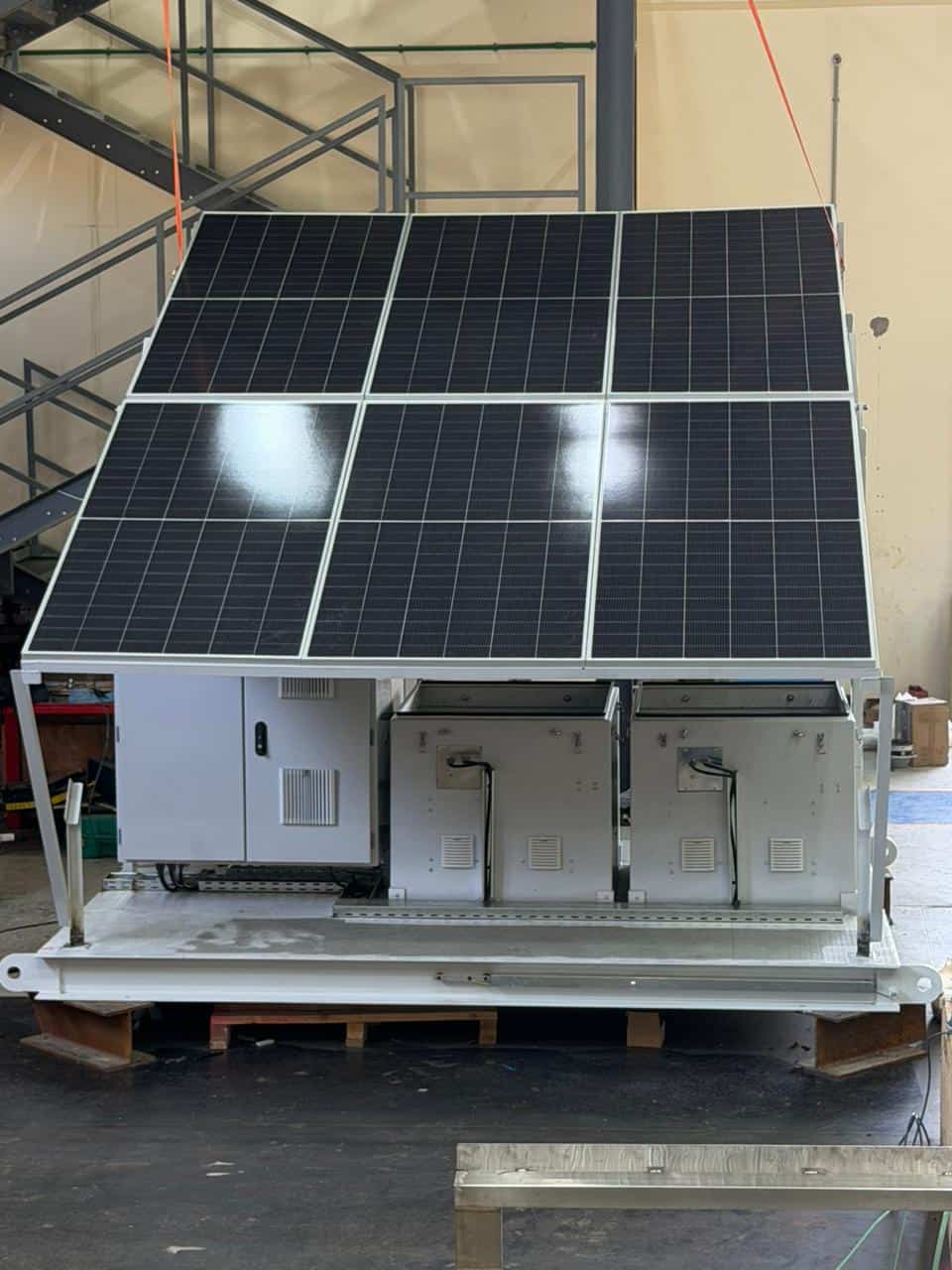
Orbital Fabrication Integrated Services, acting as EPC contractor for Oman Petroleum (OQEP), engaged DS Energy UK Ltd to engineer, supply, and commission an autonomous solar-powered chemical injection skid for a remote oilfield facility at Sohar, Oman. The installation operates with no grid connection and must maintain continuous, reliable chemical dosing to protect hydrocarbon production infrastructure.
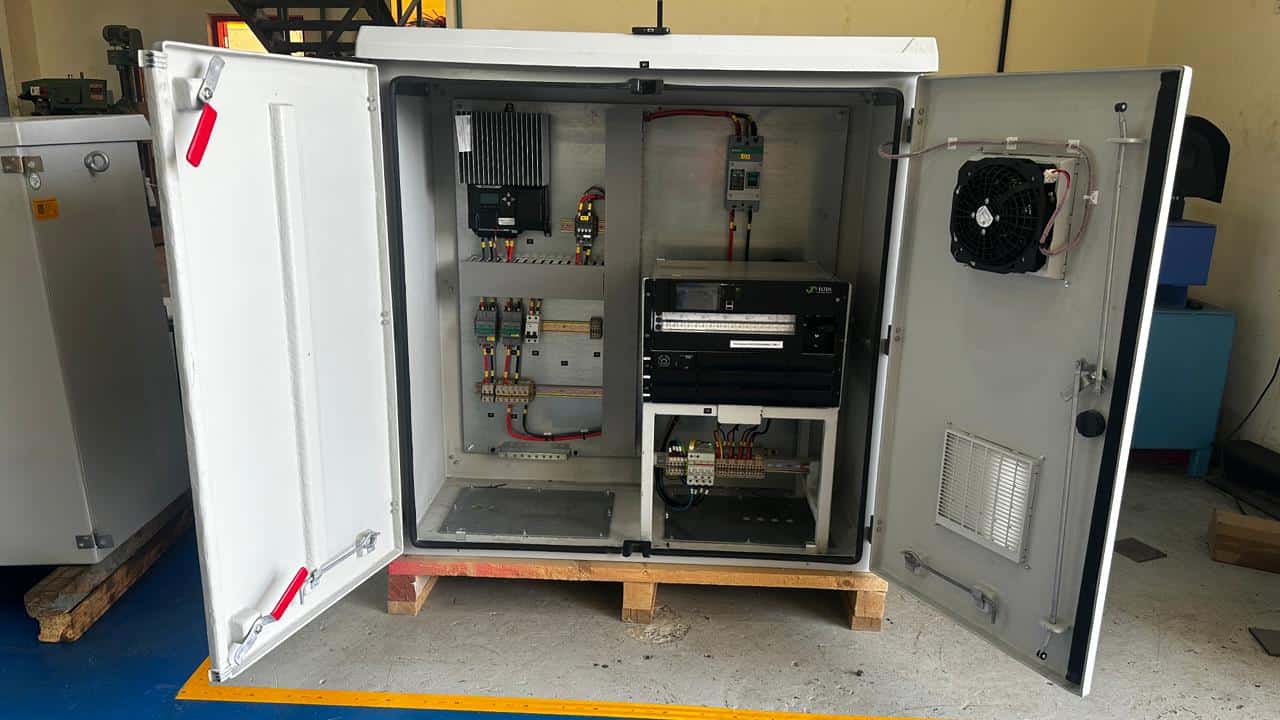
The solution is built on an 18 kVA Eltek Rectiverter platform operating at a 48 VDC bus, supplied by VSUN 600 W solar modules and regulated by a Morningstar GenStar MPPT charge controller. A Siemens S7-1500 (1515R) redundant PLC manages process control and communicates upstream via Modbus TCP/IP to a Honeywell DCS. The system serves both Zone 2 classified hazardous process loads and safe-area auxiliary loads from a single integrated power and control architecture.
Key project achievements include: zero grid dependency, sub-3% DC distribution losses, 99.5%+ system availability during commissioning baseline, full IECEx/ATEX Zone 2 compliance, and a modular skid design redeployable to additional oilfield locations without re-engineering.
Challenge:
Chemical injection is a critical process function across oil and gas production facilities. Inhibitors, biocides, scale preventers, and corrosion-control chemicals must be dosed continuously and accurately to protect pipelines, wellheads, and separation equipment. Any interruption to dosing — even for short periods — risks accelerated corrosion, scale build-up, flow assurance failures, and costly production deferrals.
The OQEP Sohar facility is located in a remote oilfield environment where grid power infrastructure is unavailable and logistical access is limited. Conventional diesel generation was assessed and rejected on the basis of fuel logistics cost, maintenance burden, emissions liability, and long-term OPEX exposure. A solar-powered autonomous system was identified as the most reliable and cost-effective solution, provided it could meet the demanding availability requirements of continuous chemical dosing operations.
OQEP further required that the solution be modular and portable — capable of being deployed, relocated, and replicated across multiple remote production sites without site-specific re-engineering. This drove the selection of a fully skid-mounted, self-contained architecture from the outset.
The project presented a range of interdisciplinary engineering challenges across power, automation, hazardous area, and communication disciplines:
- No grid power availability: The entire electrical supply — including three-phase motor loads on the chemical injection skid, PLC and control systems, RTU, and lighting — had to be derived exclusively from solar generation and battery storage.
- Continuous dosing requirement: Chemical injection pumps cannot tolerate supply interruptions. The power system was required to maintain output through low-irradiance periods, including overcast days and dust events typical of the Omani desert environment.
- Zone 2 hazardous area compliance: The chemical injection skid is classified Zone 2 (IECEx/ATEX) due to the flammable nature of the chemicals handled. All electrical equipment and cabling interfacing with the skid required Ex-rated certification and zener barrier or galvanic isolator protection.
- Safe area to Zone 2 power interface: The solar power skid is installed in a safe area, requiring carefully engineered power feeds and signal interfaces to the Zone 2 process equipment with appropriate barrier protection.
- 48 VDC bus selection: A 48 VDC system architecture was selected over conventional 24 VDC to halve distribution current for a given power level, reducing cable losses, voltage drop, and conductor cross-section requirements — directly improving efficiency and reducing installed cable cost.
- DCS integration: OQEP required full solar system monitoring to be surfaced within the existing Honeywell DCS, necessitating a structured Modbus TCP/IP integration from the Morningstar GenStar charge controller and Siemens PLC to the DCS gateway.
- Fibre optic communication conversion: Site communication infrastructure required an E2000-to-SC fibre optic conversion at the field interface, introducing a connector compatibility challenge that was resolved through custom fibre patch and converter selection.
- Modular and portable design: The skid was required to be self-contained, road-transportable, and deployable at new sites without civil works or design revision.
Solution:
Solar Power Architecture
The solar array is configured to meet a calculated daily energy demand of 12,455 Wh/day (259.48 Ah/day at 48 VDC), with design margin applied for panel soiling, temperature derating, and system losses. VSUN 600 W monocrystalline panels were selected for their high energy density and proven performance in high-temperature, high-irradiance environments. Panel orientation and tilt were optimised for Sohar’s latitude to maximise annual yield.
Battery and Autonomy Philosophy
Battery sizing was determined to provide a minimum of 3 days of autonomous operation at full load without solar input — a critical requirement for periods of extreme dust events or equipment maintenance. The 48 VDC battery bank architecture reduces string current relative to 24 V systems, improving charge controller efficiency and reducing battery interconnect losses. Battery management is performed by the Morningstar GenStar MPPT charge controller, with multi-stage charging (bulk, absorption, float) tailored to the battery chemistry deployed.
48 VDC Design Approach
The adoption of 48 VDC as the system bus voltage was a deliberate engineering optimisation. At equivalent power levels, 48 VDC halves the current compared to 24 VDC, resulting in a fourfold reduction in I²R cable losses and a proportional reduction in conductor sizing. This improved system efficiency and reduced the installed cable cost — directly supporting the remote site CAPEX profile. The Eltek Rectiverter was selected as the inverter platform due to its compatibility with 48 VDC input and proven reliability in off-grid industrial applications.
AC and DC Load Distribution
AC loads are served at two voltage levels: 415 VAC three-phase (chemical injection skid local control panel at 1.42 kW) and 220 VAC single-phase (lighting station at 10 W; PLC cabinet at 190 W). The DC bus directly supplies the RTU at 60 W, avoiding the conversion losses associated with AC-to-DC rectification for DC-native loads. Total system load is 518.97 W average, with an 18 kVA inverter providing substantial headroom for motor starting transients.
PLC and Control System Architecture
Process control is implemented using a Siemens S7-1500 Series 1515R redundant CPU — providing hot-standby failover capability for the chemical injection process. The redundant architecture ensures that a single PLC CPU failure does not interrupt dosing operations. The PLC interfaces with the chemical injection skid instrumentation, manages injection pump control, handles alarms and interlocks, and communicates upstream to the Honeywell DCS.
Communication Architecture
All communication within the system uses Modbus TCP/IP over Ethernet. The Morningstar GenStar charge controller provides solar power system status (state of charge, array current, battery voltage, fault status) to the Siemens PLC, which aggregates process and power data for onward transmission to the Honeywell DCS via Modbus TCP/IP gateway. The E2000-to-SC fibre optic conversion challenge was resolved through the installation of a compatible fibre patch assembly, enabling integration with the site’s existing fibre backbone.
Hazardous Area Compliance Strategy
The chemical injection skid is classified as Zone 2. All electrical equipment installed within or interfacing with the Zone 2 boundary is Ex-rated to IECEx/ATEX Group IIC standards. Power and signal connections crossing the safe area/Zone 2 boundary are protected by certified zener barriers or galvanic isolators installed in the safe-area PLC cabinet. Cable glands at Zone 2 penetrations are Ex-certified. The solar power skid remains in the safe area, with no non-Ex equipment deployed within the hazardous zone boundary.
System Architecture
The project was executed under a full EPC scope by Orbital Fabrication Integrated Services, with DS Energy UK Ltd responsible for solar and power system design, supply, and commissioning support.
- Engineering: Detailed design encompassed solar yield analysis, battery autonomy calculations, load schedule development, single-line diagram preparation, hazardous area equipment selection, PLC functional specification, I/O schedule, and Modbus register mapping. All designs were reviewed and approved by the OQEP engineering team prior to procurement.
- Procurement: Long-lead items including the Eltek Rectiverter, Siemens S7-1500 CPUs, Morningstar GenStar controllers, and VSUN solar panels were procured in parallel with detailed design to maintain schedule. All hazardous area equipment was procured with full IECEx/ATEX certification documentation.
- Fabrication: Skid fabrication was carried out in a controlled workshop environment. The solar power skid and chemical injection skid were fabricated as separate, interconnected modules. All electrical installations were completed to IEC 60079 and IEC 61439 standards.
- Factory Acceptance Test (FAT): A full FAT was conducted at the fabrication facility, covering power system load testing, PLC logic verification, HMI functionality, Modbus communications validation, and Zone 2 equipment certification check. OQEP and Orbital engineering representatives witnessed the FAT.
- Installation: Skids were transported to site and installed on pre-prepared foundations. Solar panels were mounted and aligned. All inter-skid cabling, fibre connections, and earthing systems were installed and verified.
- Commissioning: Site commissioning included solar array verification, battery charging system validation, inverter load testing, PLC and HMI startup, Modbus TCP/IP communications testing end-to-end to Honeywell DCS, and chemical injection skid functional testing.
- Site Acceptance Test (SAT): SAT was conducted in the presence of OQEP operations and engineering teams, confirming all performance and communication requirements against the approved design specification.
- Handover: Full documentation package including as-built drawings, equipment manuals, PLC source code, Modbus register maps, FAT and SAT reports, and hazardous area dossier was delivered to OQEP on project completion.
Features:
Technical Highlights
48 VDC Architecture Optimisation
By adopting 48 VDC instead of the industry-conventional 24 VDC, the system achieves approximately 75% reduction in I²R distribution losses for DC loads and a proportional reduction in cable conductor cross-section. This optimisation directly improved system efficiency, reduced heat generation in distribution wiring, and lowered installed cable material cost — delivering both technical and commercial benefit on a remote site where cable runs are non-trivial to modify post-installation.
Siemens S7-1500 (1515R) Redundant PLC
The Siemens 1515R hot-standby redundant PLC architecture provides automatic, bumpless failover in the event of a CPU fault. For a continuous chemical dosing application where process interruptions carry direct production risk, this level of control system availability is a critical design requirement. The redundant architecture removes the PLC as a single point of failure and reduces the maintenance risk associated with component-level CPU servicing.
Honeywell DCS Integration
Full integration of the solar power system into the Honeywell DCS gives OQEP operations personnel real-time visibility of battery state of charge, solar array output, inverter status, and system fault conditions — all from the main control room, without requiring on-site attendance. This integration transforms what would otherwise be a standalone off-grid system into a fully supervised facility asset, enabling proactive maintenance scheduling and rapid response to any power system anomaly.
Zone 2 Compliance and Safe Area Interface
The physical and electrical boundary between the safe-area solar power skid and the Zone 2 chemical injection skid is rigorously maintained. Certified zener barrier protection on all signal circuits, Ex-certified cable glands on all Zone 2 penetrations, and Ex-rated equipment on the skid itself ensure full compliance with IECEx and ATEX requirements. This approach eliminates the risk of ignition from electrical equipment in the presence of flammable chemical vapour.
Results and Benefits
| ✔ 99.5%+ system availability recorded during commissioning baseline period |
| ✔ Zero grid connection required — 100% renewable-powered chemical injection |
| ✔ Sub-3% DC distribution losses achieved through 48 VDC architecture |
| ✔ 3-day full-load battery autonomy provides resilience against extended low-irradiance events |
| ✔ Hot-standby PLC redundancy eliminates control system as single point of failure |
| ✔ Full DCS visibility enables remote monitoring without on-site attendance |
| ✔ Modular skid design supports redeployment to additional oilfield locations without re-engineering |
| ✔ Full IECEx/ATEX Zone 2 compliance achieved across all hazardous area interfaces |
The elimination of diesel generation removes ongoing fuel logistics costs, reduces greenhouse gas emissions, and removes the maintenance burden of internal combustion engine servicing in a remote desert environment. Over a 10-year asset life, the avoided fuel and maintenance costs are projected to represent a substantial reduction in OPEX relative to a diesel-equivalent solution, with the solar and battery system requiring only periodic battery replacement and module cleaning.
Key Project Data
| Parameter | Details |
| End User | OQEP (Oman Petroleum) |
| EPC Contractor | Orbital Fabrication Integrated Services |
| Solar Integrator | DS Energy UK Ltd |
| Location | Sohar, Oman |
| Application | Solar-Powered Chemical Injection Skid |
| System Bus Voltage | 48 VDC |
| AC Output — Three-Phase | 415 VAC (3-Phase) |
| AC Output — Single Phase | 220 VAC (Single Phase) |
| Solar Modules | VSUN 600 W Monocrystalline |
| Charge Controller | Morningstar GenStar MPPT 60A |
| Inverter / Rectiverter | Eltek Rectiverter, 18 kVA, 48 VDC Input, 440 VAC Output |
| PLC | Siemens S7-1500 (1515R) — Redundant Hot-Standby |
| DCS Integration | Honeywell DCS via Modbus TCP/IP |
| Communication Protocol | Modbus TCP/IP (PLC ↔ Charge Controller ↔ DCS) |
| Total Load Power | 518.97 W |
| Total Load Current | 31.25 A |
| Daily Energy Consumption | 12,455 Wh/day (259.48 Ah/day) |
| Three-Phase Load | Chemical Injection Skid LCP: 1.42 kW |
| Single-Phase Loads | Lighting: 10 W | PLC Cabinet: 190 W |
| DC Loads | RTU: 60 W |
| Battery Autonomy | Minimum 3 days at full load (no solar input) |
| Hazardous Area Classification | Zone 2 (Chemical Injection Skid) | Safe Area (Solar Power Skid) |
| Hazardous Area Standards | IECEx / ATEX — Group IIC |
| Fibre Interface | E2000 to SC conversion at site backbone |
| Skid Design | Modular, road-transportable, redeployable |
Conclusion
The OQEP Sohar Solar-Powered Chemical Injection Skid project demonstrates the successful delivery of a fully autonomous, solar-powered process control solution in a remote, hazardous oilfield environment. Through deliberate engineering decisions — including the adoption of a 48 VDC architecture, Siemens S7-1500 redundant PLC control, and full Honeywell DCS integration — the system achieves the availability, reliability, and operational transparency required by OQEP for continuous chemical dosing operations.
The combination of zero grid dependency, Zone 2 compliant power interfacing, remote monitoring capability, and a modular skid design represents a replicable solution template for autonomous power delivery across OQEP’s remote oilfield network. Orbital Fabrication Integrated Services and DS Energy UK Ltd have delivered a project that sets a technical benchmark for solar-powered process automation in the Omani oil and gas sector.
The system is fully operational, OQEP-accepted, and available as a proven reference design for future remote facility deployments