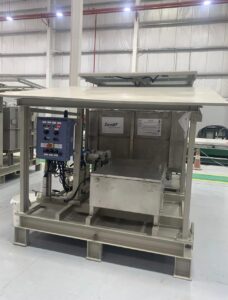
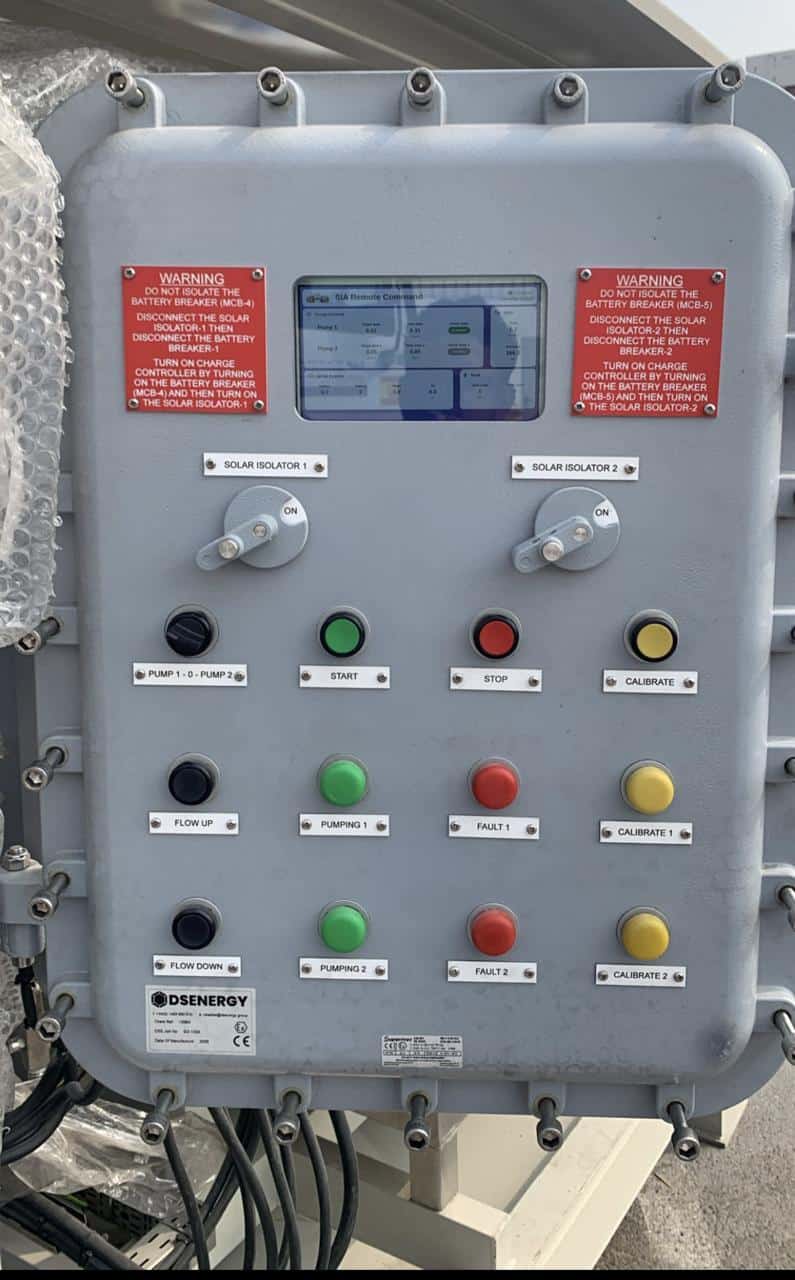
Project: Solar-Powered Chemical Injection Skid System
Project Overview
Client Name: Major National Oil Company
Location: Saudia Arabia
Project Completion: 2024
System Type: Self Contained Solar-Powered Chemical Injection Skid
DS Energy Group Limited (UK) designed, supplied, installed, and commissioned a stand-alone solar power system to operate a Chemical Injection Skid (CIS) for Zamil in Saudi Arabia, in collaboration with principal contractor Solar Injection Australia. Chemical Injection Skids are critical oil and gas assets used to dose corrosion inhibitors, scale inhibitors, and process chemicals into production pipelines to increase production efficiency and reduce corrosion. The system was engineered to power the CIS autonomously and continuously within a classified Zone-2 hazardous area, with no dependency on mains power infrastructure.
Challenge:
The primary challenge was delivering a fully compliant solar power system within a Zone-2 hazardous area classification under ATEX Directive 2014/34/EU and the IEC 60079 series (IECEx). Every component — from solar panels and batteries to enclosures, wiring, and junction boxes — was required to carry valid explosion-proof or intrinsically safe certifications, ruling out standard commercial equipment entirely. The system also had to sustain reliable operation under the high ambient temperatures and variable solar irradiance of the Arabian Gulf region, while protecting the battery banks from over-discharge and thermal stress. As the site was remote and unmanned, real-time visibility of battery state-of-charge, fault conditions, and charge status was essential, necessitating an integrated remote monitoring and communications solution.
Solution:
DS Energy Group delivered a fully self-contained, ATEX/IECEx-compliant solar power system incorporating a certified PV array, dual battery banks, a Morningstar 24 VDC charge controller, and a Doovit RTU for remote connectivity, all housed within Zone-2 rated explosion-proof enclosures. The solar array comprised ATEX/IECEx-certified panels rated for Class I Division 2 environments, providing the primary DC power source for the skid. Two deep-cycle battery banks — a 4.5 Ah and a 6.1 Ah unit — were installed in explosion-proof enclosures rated II 2G Ex e IIB T5 Gb, certified under IECEx (INE 10.0015X) and ATEX (INERIS 00ATEX0021X), providing the required energy storage and system autonomy.
The Morningstar 24 VDC charge controller, rated IECEx Ex ec ic IIC T5 Gc, was programmed with precise charge and discharge voltage thresholds, temperature compensation, depth-of-discharge limits, equalization cycles, and automatic load disconnect logic to protect battery integrity and maintain continuous availability. A Doovit Remote Terminal Unit (RTU) with a 4G antenna, housed within a Zone-2 certified enclosure, was integrated to provide real-time remote monitoring of battery status, charge state, and system fault alarms. All internal power and control components were housed within an Ex db IIB+H2 T6 GB rated explosion-proof enclosure, with all cabling, conduits, and junction boxes installed to Zone-2 requirements. A complete compliance documentation package was delivered, including a Hazardous Area Design Dossier, ATEX certifications, approved drawings, RAMS, P&ID, and Operation and Maintenance Manuals.
Features:
The system is fully ATEX/IECEx certified for Zone-2 hazardous area operation, with every component — solar panels, batteries, charge controller, RTU, enclosures, and wiring — carrying the required explosion-proof ratings. The dual battery bank configuration, comprising 4.5 Ah and 6.1 Ah deep-cycle units in certified Ex enclosures, delivers layered energy storage with built-in protection against overcharge, over-discharge, and low-voltage conditions. The Morningstar 24 VDC charge controller provides fully programmable regulation, including temperature-compensated charging, configurable depth-of-discharge limits, equalization cycles, and automatic load disconnect, ensuring long battery life and system reliability. Remote monitoring is delivered via the Doovit RTU with 4G connectivity, providing real-time visibility of battery state-of-charge, voltage levels, and fault alarms from any location. The system operates entirely off-grid with no mains infrastructure dependency, making it well suited for remote and unmanned field applications in the oil and gas sector.